

Butane Blending
Butane blending allows refiners, pipeline operators and terminals to increase the value of the gasoline pool by adding butane up to the finished gasoline’s allowable Reid vapour pressure (RVP) limit. The opportunity changes with season, region and gasoline specification.
A modern system must accurately meter liquid-phase butane, rapidly homogenise it with gasoline, measure blend vapour pressure online and continuously adjust butane addition without creating an off-specification or butane-rich blend.
Why RVP controls butane blending
Reid vapour pressure is a direct measure of gasoline volatility and is one of the most important constraints on butane addition. With an atmospheric upper reference of 14.7 psi (101.35 kPa), gasoline RVP has both minimum and maximum requirements.
Cold-weather gasoline can tolerate higher RVP. In hot weather, excessive RVP can create vapour in the fuel system. Because butane raises gasoline vapour pressure, the economically available butane-blending window expands during cooler months and contracts as summer specifications approach.
Seasonal and regional gasoline limits
More than 20 boutique gasoline grades are created in part by different regional and seasonal RVP requirements. There are Summer-control periods of May 1-September 15 for refiners and terminals and June 1-September 15 for retailers and wholesalers.
For California, the control period is May 1-October 31, with timing varying by air basin and county. There is a summer maximum of 9 psi for most states, with lower values such as 7 and 7.8 psi in some population centers, and in some areas an extension to 10 psi for gasoline containing 9-10% ethanol.
Gasoline Properties Relevant to Butane Blending
Butane addition cannot be treated as an RVP-only calculation. The finished gasoline must still satisfy octane, distillation, composition and other quality requirements.
| Quality | Specification | Typical range in article | Seasonal / regional? |
|---|---|---|---|
| RON | Minimum | 94-95 | No |
| MON | Minimum | 84-85 | No |
| RDOI | Minimum | 89-90 | No |
| RVP | Minimum / maximum | 7-14.25 psi | Yes |
| T10 | Minimum | 122-158°F | Yes |
| T50 | Minimum / maximum | 250-365°F | Yes |
| T90 | Maximum | 374-365°F as printed | Yes |
| End point | Maximum | 437°F | No |
| Sulfur | Maximum | 10-95 ppm | No |
| Olefins | – | 3-14% | – |
| Aromatics | – | 20-40% | – |
| Benzene | – | 0.09-0.31% | – |
| Drivability index | Calculated | 850-1275°F | – |
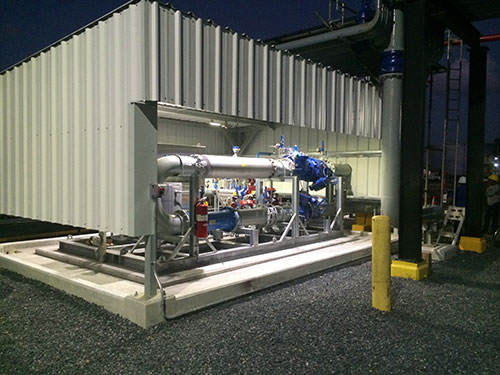
Liquid-Phase Transfer and Accurate Metering
The blending nozzle must be supplied with full liquid-phase butane. Gas production in the transfer path can prevent proper bonding with gasoline and creates operating, safety and environmental concerns downstream.
Transfer design must account for overflow prevention, strainers and shut-off valves ahead of the pump. Sliding-vane pumps are commonly used and tolerate some cavitation, but suction conditions require attention. A vertical canned turbine pump can avoid many vacuum-related problems.
100:1 turndown and two-phase monitoring
Every system must manage at least a 10:1 turndown ratio, but many applications justify 100:1. The 100:1 case can be handled with dual high- and low-flow streams, with the smaller stream’s maximum controlled flow approximately 10% of the larger stream.
Coriolis technology is also used to detect or estimate two-phase flow. Best practice is to monitor gaseous phase and automatically return it to storage rather than allow gas to continue into the blend.
Rapid mixing, injection and backpressure
After butane is measured and metered, the streams should be blended as rapidly as possible so the sample seen by the analyser is representative and the light end is retained.
If downstream process pressure is not above the vapor pressure of butane at operating temperature, a restriction such as an orifice plate or throttling valve should be used. The injection arrangement should distribute butane across the gasoline pipeline cross-section before the mixing element.
Measure the Blend Instead of Guessing
There is a contrast between online measurement with traditional mathematical prediction and designers should note that FTIR has not proven reliable enough for RVP measurement in this application. Its preferred design uses an online RVP analyzer employing the same triple-expansion method used in regulatory laboratories.
| Technical item | Article detail | Role in the blender |
|---|---|---|
| Gasoline vapour pressure | ASTM D6378 | Finished gasoline RVP / vapour-pressure verification |
| LPG vapour pressure | ASTM D6897 | Butane / LPG feed characterization |
| Repeatability | ≤ 0.50 kPa (0.073 psi) | Reduces specification giveaway while supporting customer and regulatory requirements |
| Feed measurements | RVP, vapour pressure and density | Inputs to the butane-addition algorithm |
| Blend measurement | Homogenised fuel analysed online | Closed-loop correction of butane flow to the target |
The benefit of the analyser is not only compliance. By measuring the finished blend directly, the system can move closer to the allowable RVP limit instead of leaving unnecessary specification margin.
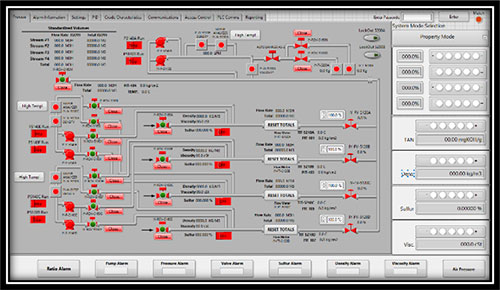
Closed-Loop Butane Addition
Technics treats the control system as mission critical because an excessively butane-rich blend creates regulatory and safety consequences while the economic value is captured in discrete seasonal batches.
- Characterise butane: ready mode samples the butane feed and records its RVP.
- Characterise gasoline: when gasoline flow is detected, the system records raw-gasoline vapour pressure and density.
- Calculate initial addition: butane flow is calculated from feed-stream density, RVP and assumptions about composition.
- Analyse the homogenised blend: the controller adjusts butane transfer to match the target while accounting for material already sent to the storage tank.
- Learn from the batch: when gasoline flow stops, a batch report is stored and the difference between calculated and actual RVP is used to modify the stored algorithm for the next transfer.
For systems that directly feed tankers, the subsequent gasoline RVP may be assumed unchanged, allowing the first three steps to be bypassed.
Economics of optimized butane blending
The economic premise is straightforward: butane can be added more profitably to gasoline than to the LPG pool. An example assumes average winter values of approximately US$3/gal for gasoline and US$0.94/gal for butane, a difference of roughly US$2/gal.
Using a simple 2-by-2 algebraic blend calculation for RON 87 gasoline and a deliberately simplified linear RVP model, the benefit from is approximately US$100,000 to US$6 million for a 100,000 bbl gasoline batch. Butane content reaches approximately 11-12% in the higher-RVP winter examples.
For more than 100 batches of 100,000 bbl over a winter season, the article estimates maximum tangible benefits of more than US$600 million. Take caution that a properly designed real control system uses a non-linear equation for final blend RVP control.
Storage and supply strategy
If LPG storage is not already available, permanent versus temporary storage becomes part of the project economics. Permanent storage is more capital intensive but can provide a guaranteed supply where local logistics are difficult.
Temporary storage can use trucks or rail and can reduce initial cost, but supplier willingness, duration and tanker capacity are possible constraints. Storage choice therefore belongs in the same economic analysis as blend margin, expected seasonal use and butane logistics.
Engineering a Butane Blending System
A butane blending project brings together LPG storage and transfer, pump selection, Coriolis metering, wide-range flow control, liquid-phase management, injection design, rapid inline mixing, backpressure control, online vapour-pressure analysis and mission-critical controls.
The engineering objective is to safely move the finished gasoline as close as practical to the required RVP target without exceeding specification. The article’s preferred architecture measures both feedstocks, controls the butane stream, verifies the homogenised blend online and uses actual batch performance to improve subsequent transfers.
Complete in-house design encompassing fluid dynamics, heat transfer, mechanical, electrical, controls, and software.
Certified Welding , Assembly, and Electrical to all Standards
Internal capabilities on a wide range of platforms.
30 Years of on-site support worldwide
- +1 (630) 938 4709
-
1005 Geneva Street
Shorewood, Illinois 60404 USA - Email: info@technicsglobal.com