
Crude Oil Blending
Crude oils vary widely in density, sulfur content, acidity, viscosity and distillation behavior. Inline blending allows multiple crude streams to be combined continuously while online measurements and automated controls maintain the required product specification.
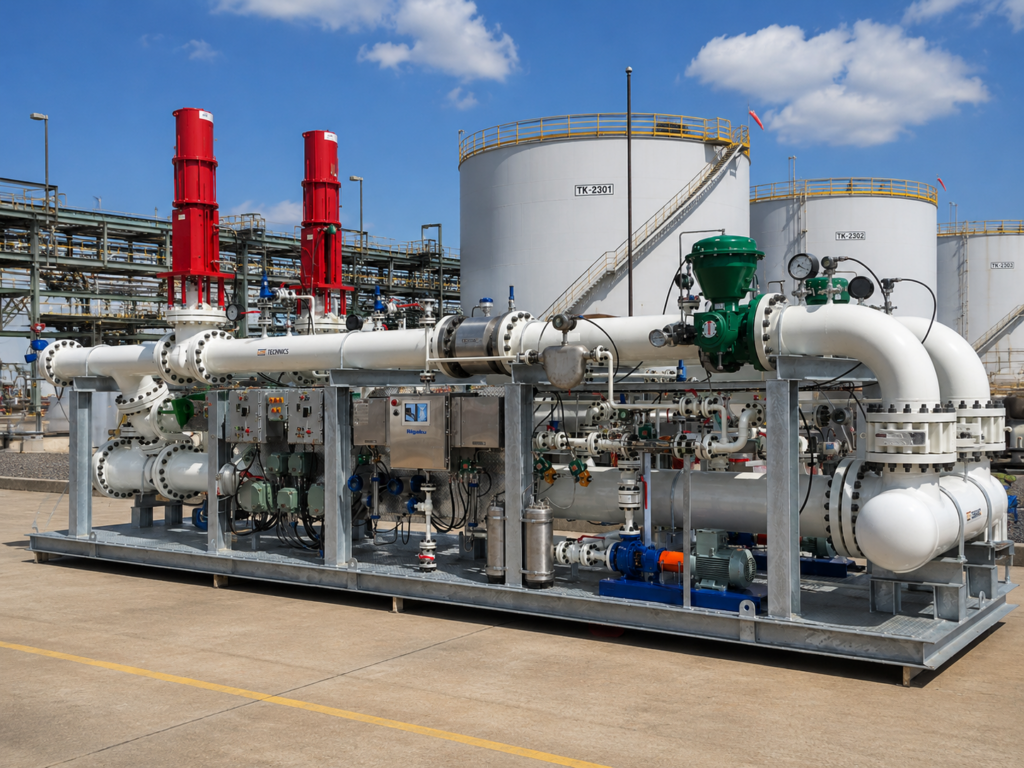
Technics integrates flow measurement, jet-mixer homogenization, online analysis, CFD verification and LOGOS control software into engineered crude blending systems for refineries, pipelines and terminals.
Why inline crude blending?
The original Hydrocarbon Engineering article contrasts inline blending with tank blending. Tank blending can require expensive storage, mechanical agitation, long blending periods, manual sampling and laboratory analysis. Correcting an off-specification tank blend can require another complete blending cycle.
An inline blender can reduce those delays by measuring the blend continuously and correcting quality deviations as they occur.
Crude properties that drive blend quality
- API gravity / density: major determinant of crude classification and refinery yield.
- Sulfur: a primary quality constraint for many crude blends.
- Total Acid Number (TAN): important because high acidity can increase corrosion risk.
- Viscosity: affects transport, pumping energy and pipeline throughput.
- Micro Carbon Residue: indicates coke-forming tendency.
Important Crude Oil Properties
API gravity is related to specific gravity by the relationship API = (141.5 / specific gravity) – 131.5, using specific gravity at 60°F. The article classifies light crude above 31.1° API, medium crude from 22.3° to 31.1° API, heavy crude below 22.3° API and extra-heavy crude below 10° API.
The article also describes crude as sweet when sulfur is below 0.7 wt% and sour when sulfur is above 0.7 wt%. TAN in crude is cited over a broad range, approximately 0.1 to 10 mg KOH/g oil, depending on the crude source.
Why Crude Quality Varies So Much
Crude oil value and refinery behavior are driven by properties that vary substantially from one source to another. The article uses API gravity and sulfur content to illustrate this variation across 160 crude oils.
API gravity is related to specific gravity by API = (141.5 / specific gravity) – 131.5. The article classifies light crude above 31.1° API, medium crude from 22.3° to 31.1°, heavy crude below 22.3°, and extra-heavy crude below 10°. Sulfur is another major blending variable: the article describes crude as sweet below 0.7 wt% sulfur and sour above 0.7 wt%.
The practical point is that a refinery designed for a relatively stable crude feed can face operating and product-yield problems when crude sources vary. Blending allows those properties to be managed before the feed reaches the CDU.

Multi-Stream Crude Blending Architecture
The article presents an example in which seven crude streams from pipelines feed five paired intermediate crude storage tanks. A linear optimizer calculates the ratios sent to each intermediate tank, and a second blending step determines the feed ratios sent from those tanks to different crude distillation columns.
This illustrates a key point: crude blending does not have to be limited to a two-stream skid. The same optimization framework can be extended to multiple crude sources, intermediate tanks and CDU destinations, with different quality and economic objectives at each stage.

Crude Blending Economics: Worked Example
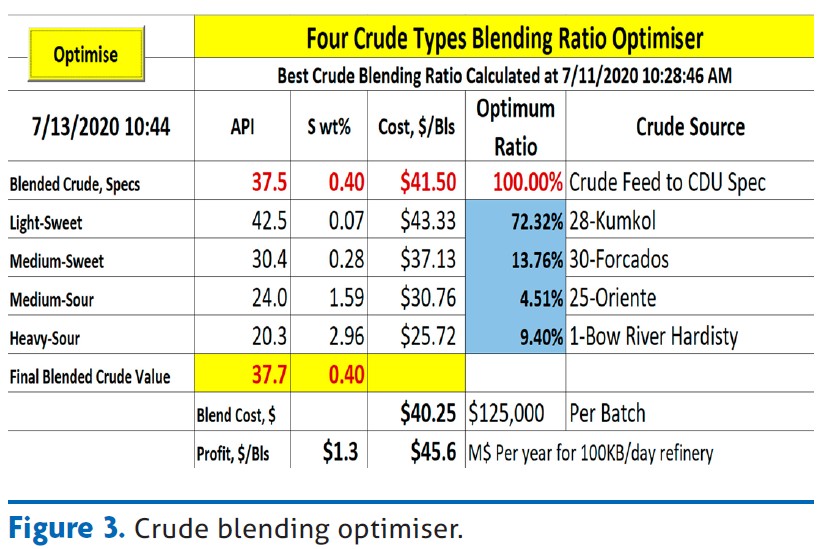
The article provides a concrete optimization example for a 100,000 bbl crude tank blended from four crude types: light-sweet, medium-sweet, medium-sour and heavy-sour.
The optimizer is constrained to produce a final blend with at least 37.5° API and no more than 0.40 wt% sulfur. It then selects the crude ratios that satisfy those quality constraints while minimizing crude cost.
In the published example, the optimized blend is approximately 37.7° API and 0.40 wt% sulfur, with a blended crude cost of about US$40.25/bbl. The example is valuable because it shows how crude blending becomes an economic optimization problem rather than simply a ratio-control problem.
For traders, the same methodology can be used to compare purchase cost against selling price. For refiners, it can support feedstock valuation and negotiation by quantifying the economic effect of different crude combinations.
Integration With Refinery Optimization
The article argues that crude blending delivers greater value when it is integrated with the rest of the refinery’s quality-control and planning architecture. Feed-quality control modules can include movement planning, movement monitoring, crude-tank composition monitoring and quality control of the crude-unit feed.
Product-quality control modules can then provide downstream feedback from product blending, online component analysis and crude-unit models. That feedback can influence the target crude-feed composition rather than leaving the crude blender to operate against a fixed manual target.
In practical terms, the crude-blending optimizer can become part of a larger refinery optimization loop: upstream crude availability, crude-unit operation and downstream product requirements all contribute to the target blend.

Limitations of Tank Blending
- Large tanks are expensive to build.
- Motorized agitators add operating and maintenance cost.
- Blending, manual sampling, transport and laboratory analysis can take days or weeks.
- Obtaining a representative sample from a large storage tank is difficult.
- Correcting an off-spec blend requires another blending and sampling cycle.
- Some light-product additions can promote asphaltene precipitation and create tank-cleaning cost.
Advantages of Inline Blending
- Lower capital cost than dedicated blending tanks in many applications.
- Minimal additional blending energy because the mixing loop operates at relatively low differential pressure.
- Online analyzers measure blend characteristics in or near real time.
- Off-spec conditions can be corrected immediately instead of waiting for another tank cycle.
- A properly designed mixing and analysis loop can provide a representative sample.
- When feeding a CDU directly, crude composition can be adjusted in minutes to support refinery optimization.
Flow Control and Homogenization
Two or more crude streams are measured and controlled to maintain the required blend ratio. In many applications the blender does not determine total downstream flow; it must continuously balance the component streams as refinery or pipeline conditions change.
Representative online analysis requires the individual streams to be thoroughly mixed before the sampling location. Technics designs the blending and recirculation arrangement so the analyzers see a representative product rather than a partially mixed stream.
Jet mixing and CFD verification
The article identifies jet mixing as the preferred homogenization method for the described crude blender. A recirculation pump withdraws blended fluid downstream and injects it upstream through a nozzle, generating turbulence before the analyzer sample point.
Nozzle geometry and jet-loop flow are critical design variables. CFD should be used to verify that the crude is adequately homogenized before analysis across the intended operating range.
Control without disturbing downstream flow
The control system must change component ratios without creating an unacceptable disturbance in total flow. The article describes PID control with gains and valve-closure limits to account for feed-pressure differences.
Speed is not always desirable: ratio changes should be made deliberately enough to prevent disruption of the downstream crude distillation unit or pipeline.
Online Measurement and Analysis
Representative online analysis is the feedback mechanism that allows the blender to correct quality in real time. The article’s measurement table identifies the following combinations:
| Property | Measurement | Mode | Purpose |
|---|---|---|---|
| Density | Coriolis | Online | Control; tank composition and refinery product slate |
| Sulfur | X-ray fluorescence | Online | Control; optimize HDS capacity and minimize sulfur giveaway |
| TAN | Titration / online algorithm | Lab / algorithm | Control corrosion-related quality |
| Distillation points | Distilled volume vs. temperature | Online / offline | Control and monitor CDU cut points |
| BS&W | Capacitance | Online | Monitor water in crude |
| Viscosity | Vibrating fork | Online | Monitor/control pipeline transport and pumping cost |

Blend Control and Optimization
Once the mechanical system and analyzers are properly selected, the control system coordinates the entire process. Measured characteristics can be assigned target values, acceptable ranges and priorities.
The optimizer can protect high-priority constraints first, then improve lower-priority properties where the available feedstocks allow it. The objective is not simply an acceptable blend, but an economically advantageous blend that remains within specification.
What the economics example demonstrates
The worked example above demonstrates the basic optimization logic: each available crude has a different cost and quality, and the optimizer chooses the combination that satisfies the required API and sulfur limits at the lowest calculated crude cost.
That framework can be extended to additional crude streams and additional constraints such as viscosity, TAN, distillation characteristics or other refinery-specific quality targets.
Feedstock compatibility matters
The article warns that chemically incompatible feedstocks can create asphaltene precipitation, particularly when distillates are introduced into some heavy crudes. Compatibility should therefore be evaluated as part of a crude-blending project.
Viscosity management can also create value in pipeline applications by reducing horsepower requirements and increasing potential throughput.
Blending Control Logic
- Maintain the required ratio without shutting off or starving downstream crude flow.
- Use PID control with appropriate gain settings and valve-position limits.
- Assign each quality parameter a target, acceptable range and priority.
- Optimize lower-priority parameters only while higher-priority properties remain within limits.
- For multi-stream systems, designate the most effective crude stream for correcting each property.
Crude Blending Economics
Crude blending can create value by reducing specification giveaway, improving inventory flexibility, supporting just-in-time crude management and reducing demurrage. For traders, blending can be used to meet pipeline specifications; for refiners, it can help establish the most economical feed composition that still meets crude-unit requirements.
The article’s optimizer example uses crude price together with API and sulfur constraints to calculate a lower-cost blend. That same concept can be extended to larger numbers of crude streams and additional quality variables.
Engineering an Inline Crude Blending System
Crude blending performance depends on integrating the mechanical design, flow instrumentation, homogenization system, online analyzers and controls as one process. Technics applies fluid mechanics, CFD, instrumentation and LOGOS control software to engineer the system around the required flow range, crude properties, quality targets and downstream operating constraints.
Complete in-house design encompassing fluid dynamics, heat transfer, mechanical, electrical, controls, and software.
Certified Welding , Assembly, and Electrical to all Standards
Internal capabilities on a wide range of platforms.
30 Years of on-site support worldwide
- +1 (630) 938 4709
-
1005 Geneva Street
Shorewood, Illinois 60404 USA - Email: info@technicsglobal.com