
LOGOS-Managed Lubricant Blending Processes
Efficiency Defines Profitability in Lubricant Manufacturing
Lubricant manufacturing is a mature industry where success depends on operational excellence rather than proprietary secrets. The most profitable plants are deliberately designed around five core principles:
- Optimized throughput through the selection of the right blending method for each production need.
- Precise metering that ensures expensive additives are used efficiently without overuse or loss.
- Elimination of human-error cross-contamination, which can turn an entire 50,000-liter batch into boiler fuel. LOGOS software guides operators and prevents mistakes.
- Mechanical cross-contamination prevention via kettle washing, pipe pigging systems, and piggable manifolds.
- Intelligent production management that presents operators with the cost of every available formula, enabling the most economical production path.
Flexible Blending Solutions for Every Scale and Need
All lubricant plants follow a similar overall flow—receiving, storage, blending, storage, and shipping—but Technics provides tailored blending technologies to match any operation, from 10,000 to 500,000+ metric tons per year.
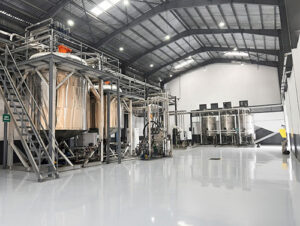
Automatic Batch Blending (ABB)
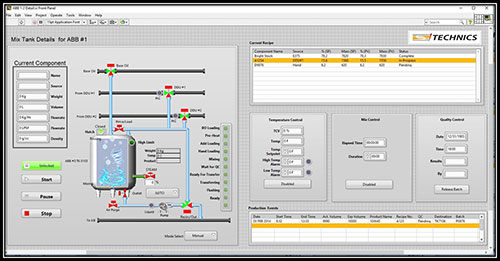
Ideal for very small batch sizes, ABB uses kettles up to 20 m³ with paddle agitation. Components can be added manually if needed. ABB is the most versatile and least costly method, typically heated, easy to rinse, and measured by weigh scales. It excels where flexibility and thorough cleaning between batches are priorities.
Simultaneous Metering Blending (SMB)
SMB meters components simultaneously into a tank that requires post-blend agitation (via air mixing or eductors). It uses mass flow meters (preferred) or gear meters, requires fewer channels than inline systems because components can transfer sequentially, and moves faster by transferring additives alongside heated base oil. Technics ILB systems can operate in SMB mode when needed.
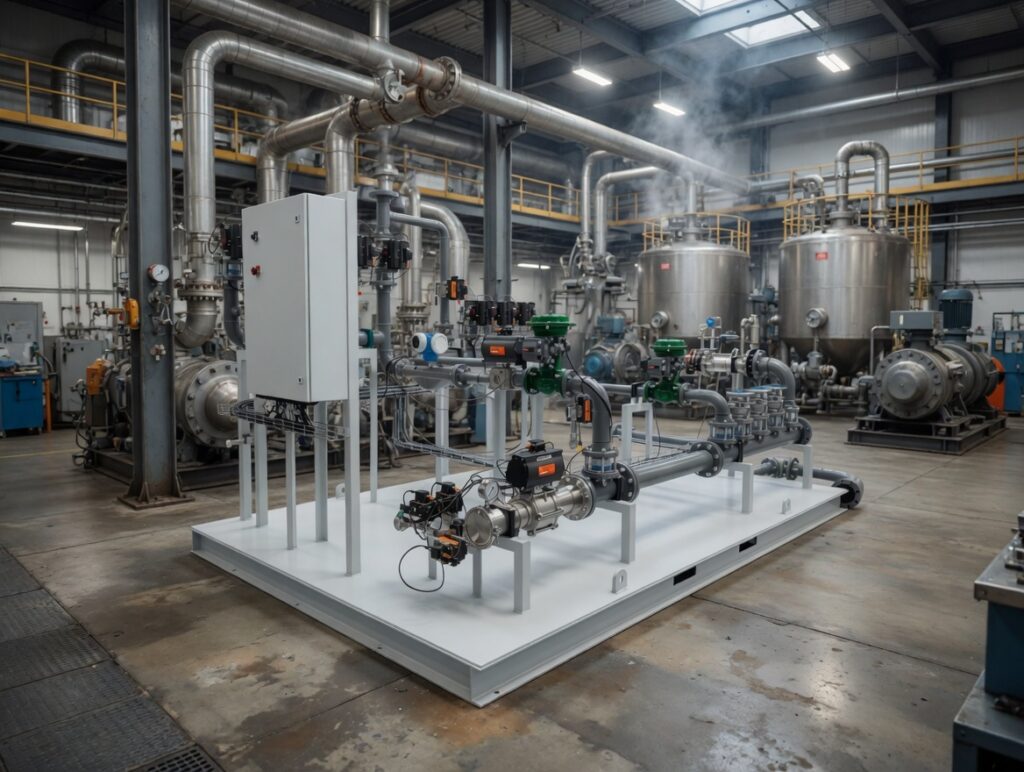
Inline Blending (ILB)
ILB meters all products proportionally and uses a static mixer at the end of the machine for immediate, full homogenization. With no theoretical upper batch size limit, finished product can go directly to transport or packaging. ILB systems require a small flush of base oil before and after each blend, giving them a practical lower batch size limit. While more expensive, they deliver maximum speed and quality for high-volume operations
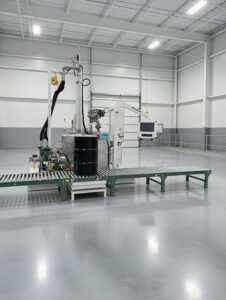
Drum Decanting Units (DDU)
Precisely transfer expensive additives from drums into ABB kettles or SMB processes using weigh scales. Integral cleaning and LOGOS-guided drum verification (with optional barcode reading) eliminate contamination and human error.
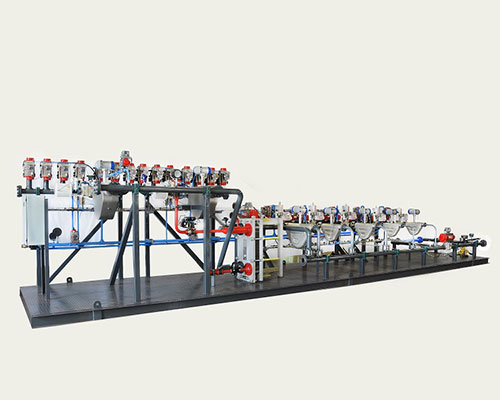
Pigging Systems
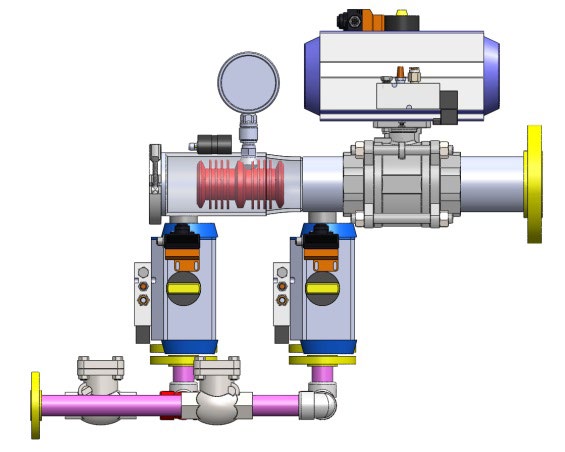
Essential for versatile plants. Pigs, launchers/receivers, and piggable directional manifolds prevent cross-contamination. Systems can be manual or automated; exhaust air is treated in a coalescer. Heated base oils can sometimes suffice for cleaning, but pigging provides superior versatility.
LOGOS Enterprise Software
LOGOS Enterprise integrates all aspects of lubricant blending, connecting seamlessly to existing SQL/ODBC accounting systems for sales orders, quotes, and RMAs. This user-based platform delivers:
- Raw material, product, and production planning
- Blend optimization and correction
- Package fill management
- Real-time inventory and production summaries
- Truck/railcar planning with RFID
- Inbound/outbound scheduling
- Laboratory analysis integration (LIMS)
- Comprehensive data collection and multi-language support
Operators and managers gain complete visibility and control, ensuring every batch meets specifications at the lowest possible cost.
Machinery Control
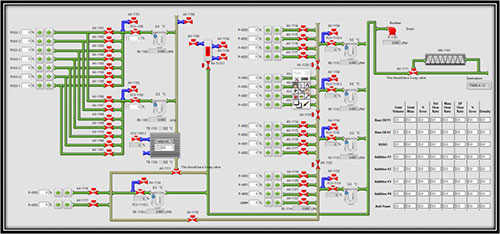
LOGOS Machinery SCADA ensures that the simultaneous blending of multiple components is executed in exact accordance with the blend recipe. The system utilizes database tables that are shared with the LOGOS Enterprise. Any number of recipe spreadsheets can be stored on the enterprise system, with only today’s production presented to the plant floor for processing. This provides a certain amount of administrator control.
Tank Farm Monitoring
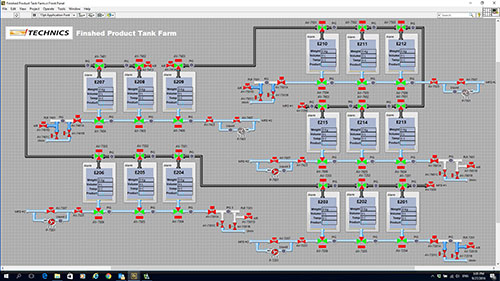
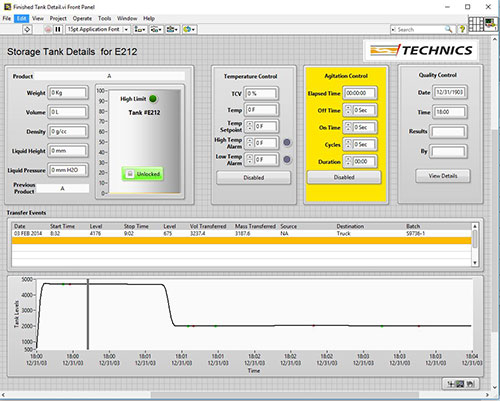
The LOGOS system is a comprehensive inventory management system. By utilizing our hybrid level monitoring, the system stores not only the name of the fluid and the volume but includes the density of the stored fluid, temperature control, and product name. The system interacts with the cross-contamination data base and disallows the receipt of incompatible fluids.
This is particularly important for swing tanks as it is possible to allow for incompatible fluids as long as a jointly compatible fluid is stored in the tank between the others.
The tank screen will show not only the current and passed liquid volumes, densities, and weights, but it will display the amount of its current contents that is scheduled for production.
PIgging & Routing
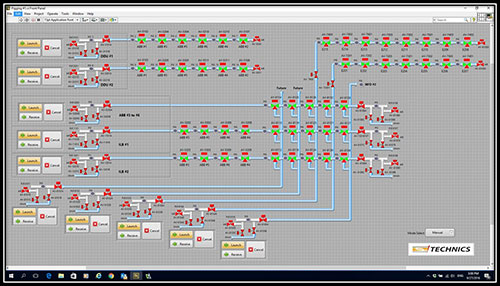
A single point for routing finished product from production to storage to packaging. This matrix is fully integrated with the SCADA system and will automatically prevent the opening of valves into and out of tanks if that product is a threat to previously stored product s. The multi-dimensional aspect of this system allows for the use of swing tanks. For instance, it is possible for material A to reside in a tank previously filled with material B as long as there has been a sufficient volume of material C in between.
Inventory Control
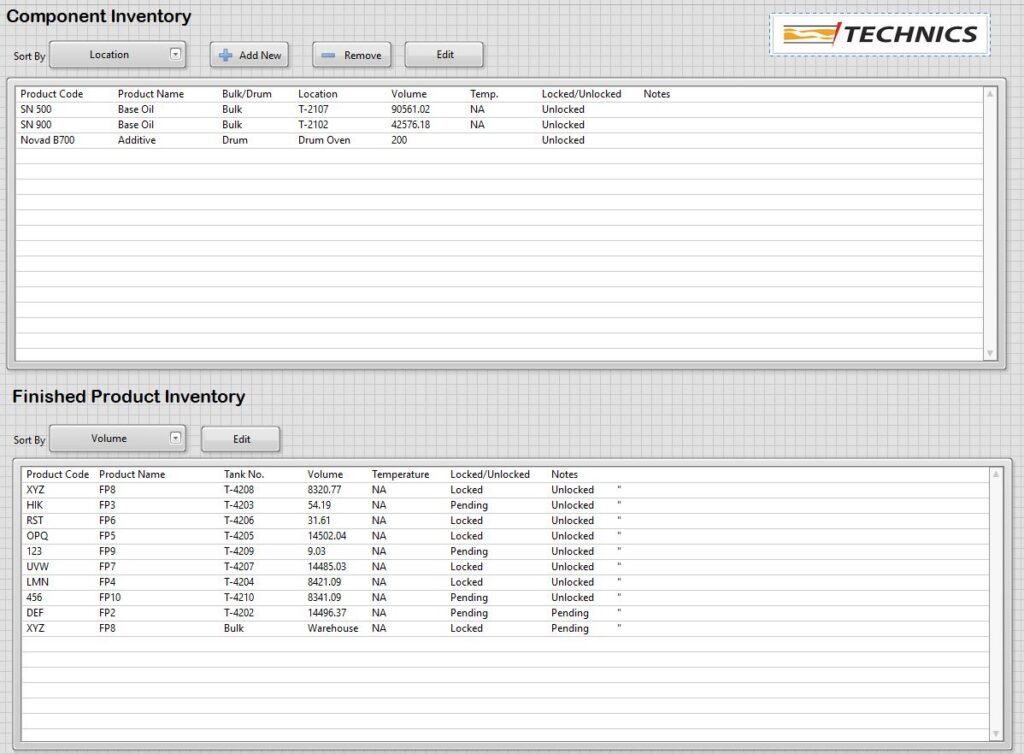
The inventory module stores component products (both Bulk and drum) in a single spreadsheet that can be downloaded and transferred at any time for inventory reporting to management. The operator can edit, delete, and add new product. Finished product inventory is automatically populated after a production run.
Recipe Management
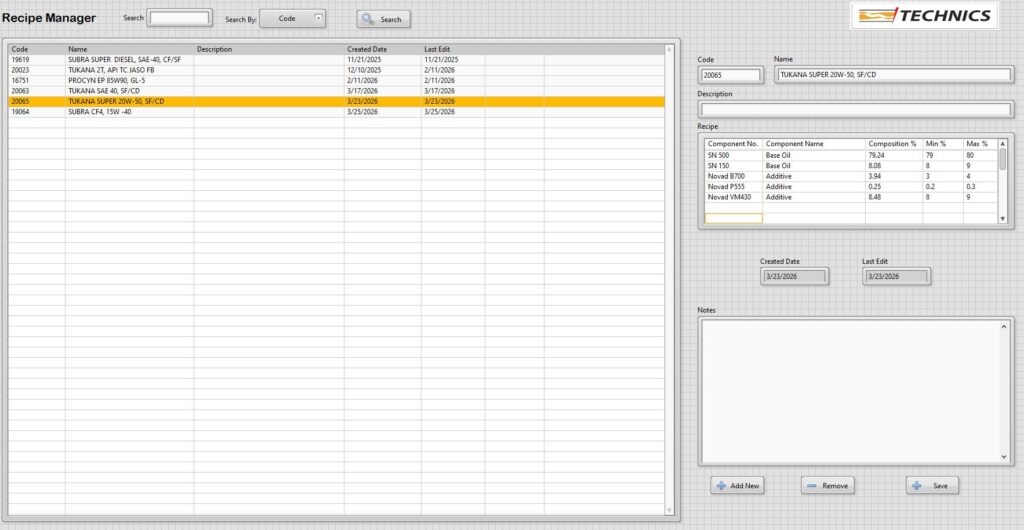
Recipes are stored in a spereadhseet and presented to the operatore for addition., deletion, and editing. A search function is utilized to manage 1000 of formulations.
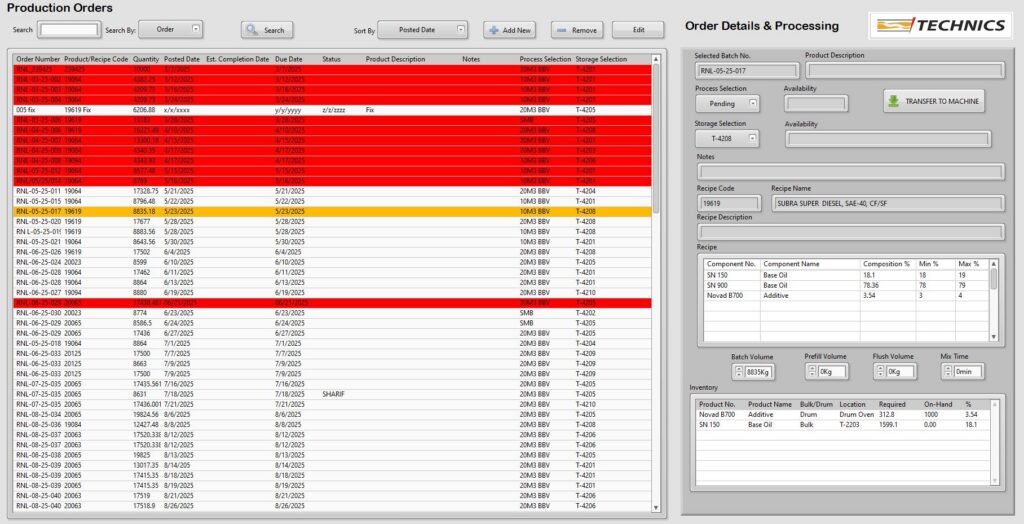
Prduction Scheduling
The production scheduling module allows for inputting new orders and tracking those already entered especially with respect to due date. Orders that are to be complete within the day are highlighted in yellow wile late orders are highlighted in red. When ready for production, the user selects the order which interacts with the recipe manager to display the recipe associated with that order. It further queries the inventory manager and displays the quantity required to complete the order as well as the quantity on hand and where it is located.
Once selected for production the operator selects the process desired (i.e. batch or Inline) and transfers it to the machine module where it is placed in queue for processing.
30 Years of custom design producing a proven suite of solutions
Frequently Asked Questions
What does Technics provide for lubricant blending plants?
Technics provides integrated lubricant blending solutions that combine process design, machinery, instrumentation and controls, and management software for lube oil blending plants. The LOGOS-managed processes aim at higher throughput, more diverse formulations, and assured product quality.
What is a LOGOS-managed lubricant blending process?
A LOGOS-managed lubricant blending process is Technics’ integrated approach to operating a lube oil blending plant. LOGOS combines hardware and software to manage plant operations, control embedded I/O and PCs, communicate with field devices, and support recipe execution, inventory supervision, and logistics reporting.
What challenges do lubricant blending systems need to handle?
Modern lubricant blending processes must handle a wide array of materials with wide-ranging flow rates, viscosities, and temperatures. Emphasizing the risk of cross contamination, making proper design, fabrication, valving, metering, and instrumentation especially important.
What is included in Technics’ scope of work for lube oil blending plants?
Technics’ scope includes process design, plant layout and piping, packaged processing skids, blending vessels, instrumentation and control systems, facilities and process management software, and broader implementation support.
What does LOGOS Machinery SCADA do?
LOGOS Machinery SCADA ensures that simultaneous blending of multiple components is executed in exact accordance with the blend recipe. It uses database tables shared with LOGOS Enterprise, allowing recipe spreadsheets to be stored centrally while presenting only the current production data to the plant floor.
What is LOGOS Enterprise used for?
LOGOS Enterprise is used as the higher-level system that stores recipe spreadsheets and shares database tables with LOGOS Machinery SCADA. This setup helps manage production data and provides a degree of administrator control over what is presented to operators.
What does the LOGOS Tank Farm Module do?
The LOGOS Tank Farm Module supervises the inventory of material connected to the process, including its location and other parameters. This positions it as the inventory and material-management layer within the lubricant blending plant.
What does the LOGOS Logistics System do?
The LOGOS Logistics System manages bulk loading and unloading operations to trucks, rail, and barges. It interacts with the transfer platform, generates reports for received inventory and custody transfer, and captures data from devices such as scales and meters during loading and unloading events.
Can Technics support recipe management for complex lubricant formulations?
Yes. Customers need to manufacture an increasing number of formulations with greater complexity. LOGOS and its shared recipe/database structure as part of the solution for managing those recipes and executing blends accurately.
How does Technics help lubricant manufacturers stay on-time and at-spec?
On-time, at-spec, every-time production is achieved with the combined use of properly designed machinery, recipe-based control, integrated plant software, instrumentation, and logistics/inventory modules working together within the LOGOS-managed process.
Complete in-house design encompassing fluid dynamics, heat transfer, mechanical, electrical, controls, and software.
Certified Welding , Assembly, and Electrical to all Standards
Internal capabilities on a wide range of platforms.
30 Years of on-site support worldwide